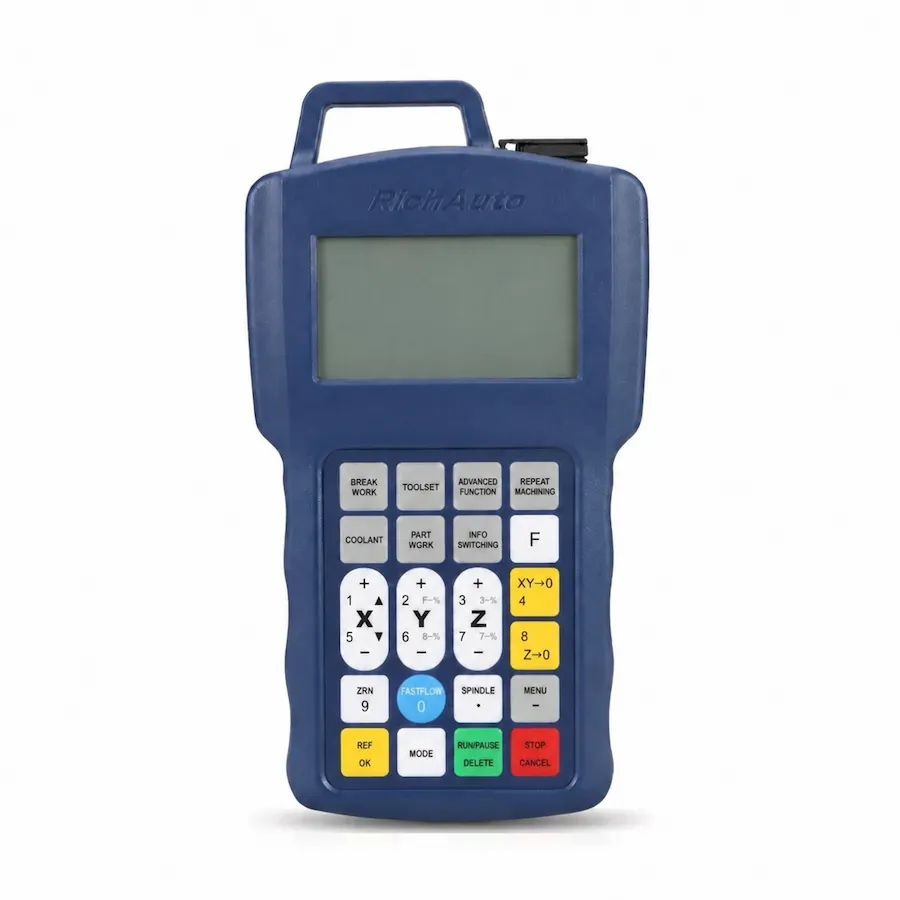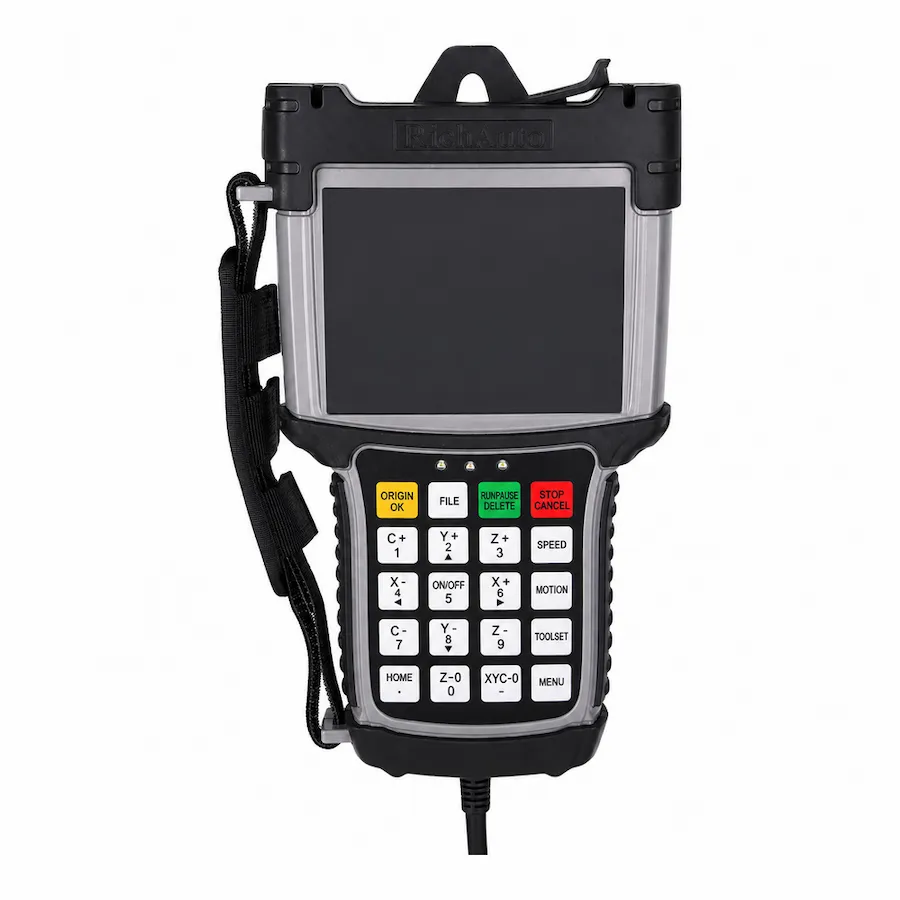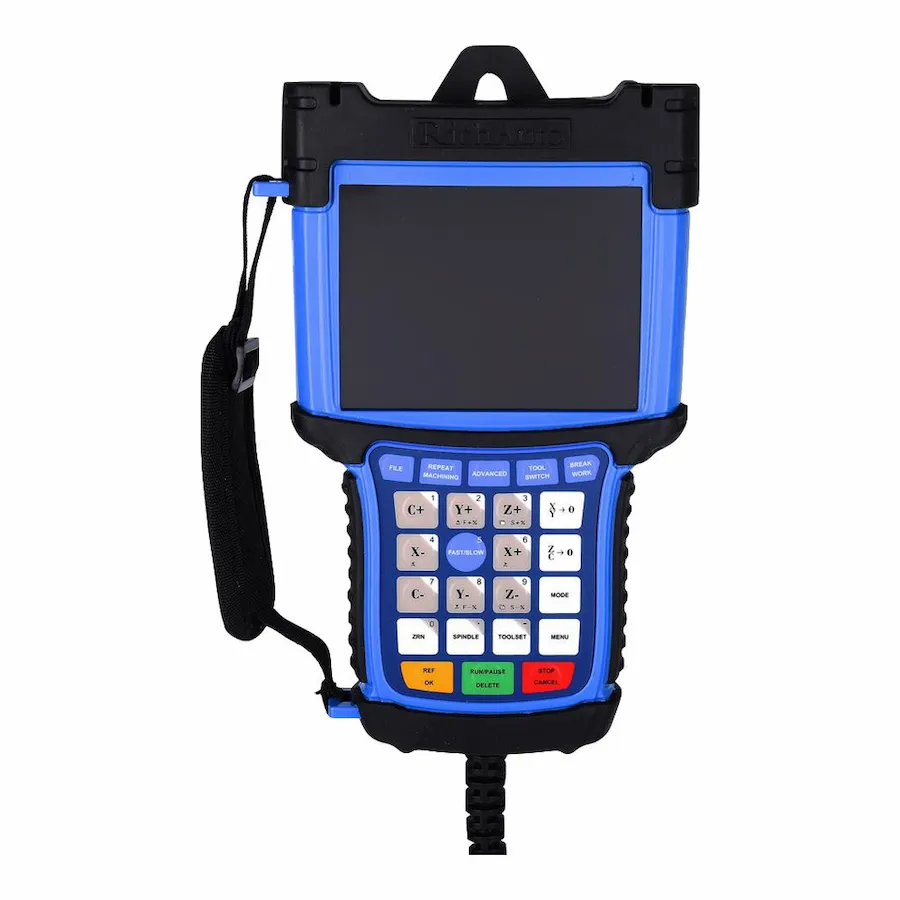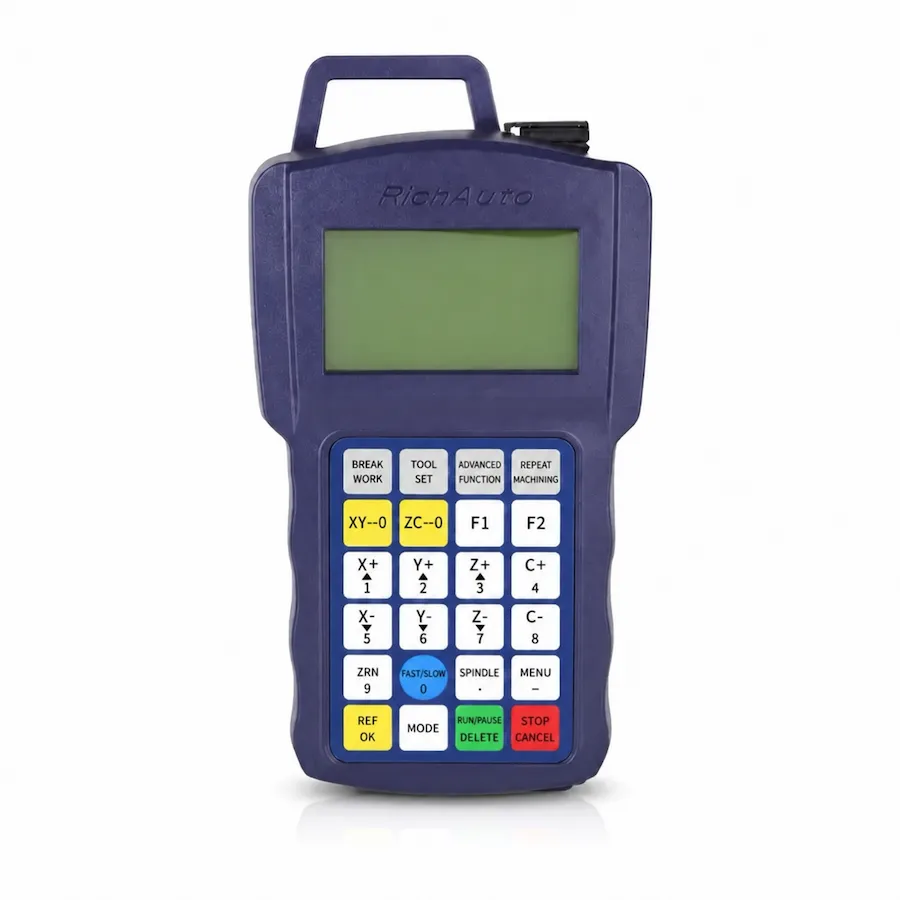
RichAuto B11 and B51 are both relevant to conventional three-axis CNC machines, but they should not be treated as interchangeable handheld controllers. The selection should reflect the machine’s display preference, required I/O, control-board arrangement and the functions that must continue to work after installation.
B11: Compact 3-Axis DSP with Spline Interpolation
The B11 is a B-series handheld DSP controller for standard three-axis routing and engraving work. It includes spline interpolation, nine workpiece coordinates and breakpoint positions, and a compact monochrome handheld panel. It may be considered alongside A1X-family equipment only after the interface board, pinout, signal, power and wiring have been checked for the actual machine.
The B11 uses a standard 8-input/8-output interface. Machines that need more external signals, a larger operating screen or handwheel operation move into the B5X platform rather than extending the compact B1X handheld.
B51: Color Display and Configuration-Dependent Options
The B51 is positioned for three-axis CNC work with a 5-inch color screen, simulation preview and real-time G-code viewing. Its standard board is 16-input/8-output, and expanded I/O and handwheel operation depend on the supplied configuration, so those features must be confirmed from the actual board and machine requirements.
Memory, communication and pulse capability can also vary by B5X hardware revision. A color display alone does not establish compatibility with an existing cabinet.
B11 vs B51: What Actually Differs
The practical difference between the two controllers is the operating interface and the I/O room around it. The B11 keeps the compact monochrome handheld format and the standard 8/8 interface that suits conventional three-axis machines. The B51 adds a larger color screen, a 16/8 board, optional expansion, handwheel support and network connection.
Display preference is not the only decision point. Count the signals the machine actually requires — limits, alarms, spindle control, pneumatic or cylinder outputs and auxiliary equipment — then check whether the installed cabinet and interface board can support the selected controller. Both models remain three-axis controllers, so a fourth axis or an automatic tool changer is a platform change rather than a configuration choice.
A Practical Selection Checklist
Start with the machine application and confirm that a conventional three-axis controller is appropriate. Then record the existing controller label, interface-board photos, terminal labels, power arrangement, drive type, I/O list and cabinet wiring. If the machine needs a fourth axis, ATC, plasma or multi-spindle control, compare a controller intended for that machine architecture instead of extending a three-axis platform.
For replacement work, preserve the existing parameters and wiring evidence before disconnection. CINKR can use those details to evaluate the practical controller fit before quotation.
For a broader view of how three-axis and four-axis machines differ, compare the related controller guides below, and send the machine details to info@cinkr.com for a compatibility review.