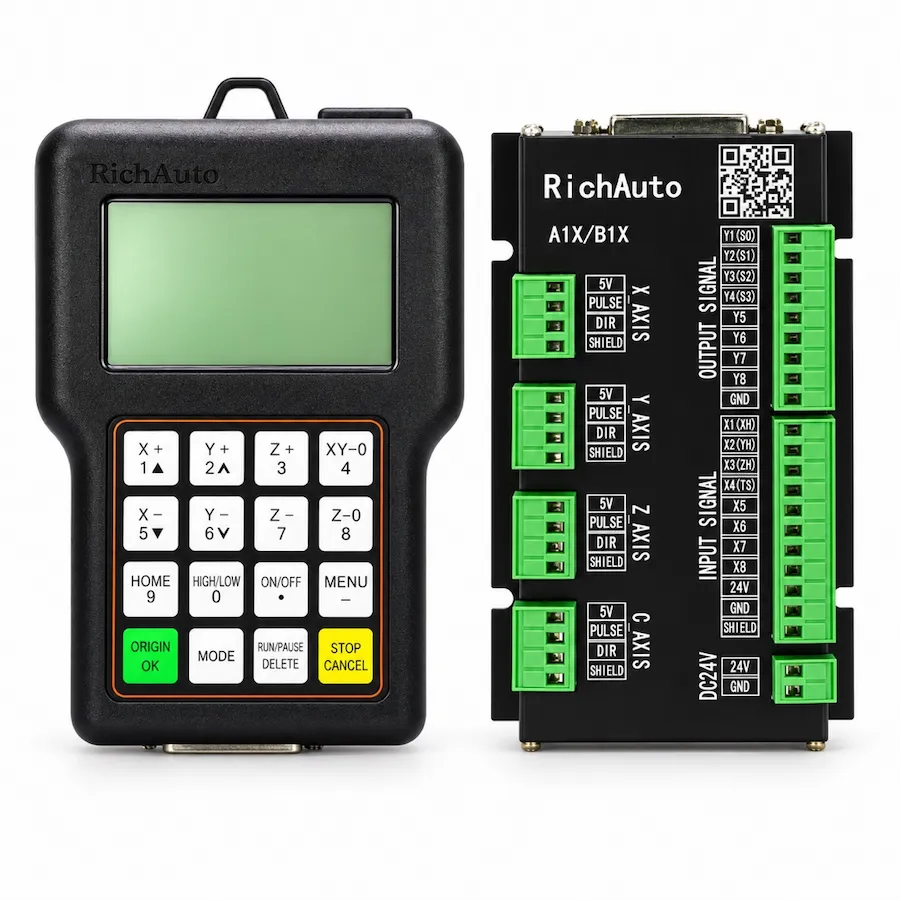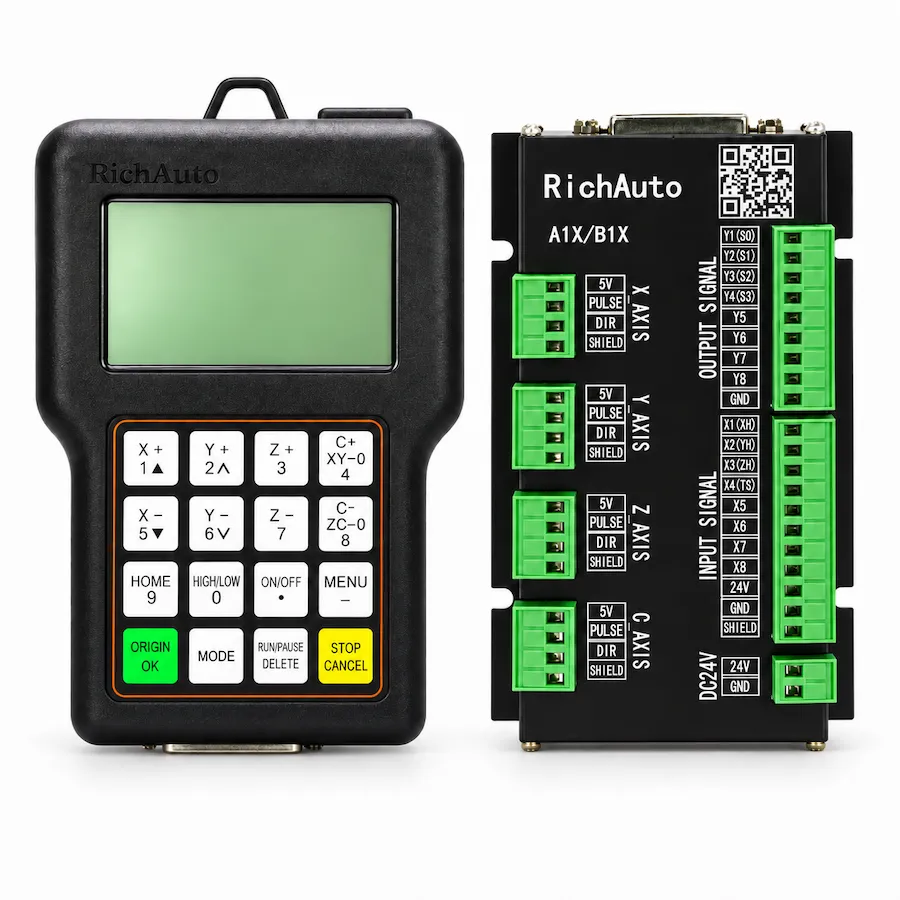
A RichAuto controller price is not a single number attached to a model name. It is the total of a supplied set, a quantity, a delivery term and a destination. Two offers that both say “RichAuto A11” can differ substantially because one includes a handle, a matched interface board and a cable set while the other supplies the controller alone. Comparing the headline figure without comparing the contents produces a decision that looks informed and is not.
This guide explains the factors that move a quotation, how to read two offers side by side, and which details to send so the quote matches the machine you actually have.
The Factors That Move a Quotation
Six factors account for most of the variation between offers.
Scroll horizontally to read all columns.
| Factor | What varies | Why it changes the total |
|---|---|---|
| Controller model and suffix | Range and version designation | Different hardware and firmware branch |
| Handle and keypad | Type, language, supplied or separate | A separate handle is a separate line item |
| Interface board | Board revision and signal type | Stepper and servo arrangements use different boards |
| Cable and connector set | Length, connector type, included or not | A matched set reduces installation work |
| Quantity and packing | Single unit or batch, export packing | Batch handling and packing change unit cost |
| Delivery term and destination | Freight, insurance, duty, local handling | Charges outside the product price appear on arrival |
A quotation that lists these lines is easier to compare than one that lists a single figure. It also makes a later shortage visible: if the handle was never in the offer, its absence on delivery is not a missing part, it is a missing line.
Why the Same Model Appears at Very Different Totals
Marketplace listings are built to be found, not to be compared. A listing may show a controller photograph while the price refers to a subset of the supplied items, or to a different board revision. Some listings combine a controller, handle and cable set; others price the controller alone and expect the buyer to source the rest.
There is also a legitimate range within the same model. Different board revisions, different keypad languages and different packaging for export all change cost. None of those differences is visible in a title that reads the same on two listings.
The practical rule is to ask for the supplied set in writing. A supplier who can itemise the handle, board, cable set and packing is describing a real configuration; a supplier who cannot is describing a title.
What a Configured Quote Should List
Use this list to check any quotation, including one from CINKR.
- Controller model and the designation on the label, including any suffix.
- Handle or keypad, with its type and language, listed separately if it is a separate item.
- Interface board revision and the signal type it supports.
- Cable and connector set, with length and connector type.
- Quantity, unit price and the total for the batch.
- Packing method, particularly for export or multiple units.
- Delivery term, freight, insurance and any charge payable on arrival.
- Warranty period and the process for a fault claim.
A quote that omits the delivery term is incomplete rather than cheap. Duty and local handling vary by destination and are normally payable outside the product price, so a comparison that ignores them can invert the order of two offers.
Comparing Two Offers
Scroll horizontally to read all columns.
| Comparison point | What to check | Why it decides the comparison |
|---|---|---|
| Supplied items | Handle, board, cable set, documentation | Two totals for different contents are not comparable |
| Board revision | Marking on the board, signal type | A different board can change the installation work |
| Firmware branch | Version supplied and update path | A version that does not match the board creates rework |
| Quantity basis | Unit price at the requested quantity | Batch pricing changes the unit cost |
| Delivery term | Included and excluded charges | The landed cost differs from the quoted price |
| Support | Who answers a compatibility question | Support cost appears after delivery, not before |
Compare the landed cost for the same quantity, the same supplied set and the same destination. If one offer cannot state its board revision, that is the first question to resolve, because the board decides whether the controller fits the machine at all.
Two Offers, One Comparison
Consider two offers for the same model. The first lists the controller, a handle, a matched interface board and a cable set, with freight and duty stated separately. The second lists a controller at a lower figure, with the handle and cable set described as optional and delivery arranged on the buyer’s account.
The second offer is not necessarily worse value, but it is a different scope. Add the missing items and the destination charges before comparing, and the difference between the two totals usually narrows. If it does not narrow, the board or the firmware branch is the next thing to compare.
This is why a quote that itemises is easier to trust than one that does not. The itemised version can be checked line by line against the machine, while the single figure can only be accepted or rejected.
What Changes When the Quantity Changes
Batch orders change the calculation in ways that a single-unit quote does not show. Packing, handling and freight are shared across the batch, so the unit cost usually falls, while the total commitment rises.
Ask for the unit price at the quantity you actually intend to order, and ask what happens to the total if the quantity changes. A quote built around a single unit can look uncompetitive against a batch price for a different quantity, and the comparison then says more about the quantity than about the supplier.
When a Lower Total Is the Wrong Choice
The cheapest offer is the wrong choice when it omits an item the machine needs, when the board does not match the existing interface, or when the delivery term leaves the destination charges unknown. Each of those outcomes converts a saving into a second order or an installation delay.
It is also worth separating the controller from the installation. A replacement that arrives with the right board still needs the existing parameters recorded and the wiring checked. The replacement checklist covers that preparation, and the A11 product page lists what to photograph before ordering.
Send the Details That Make the Quote Accurate
A quotation is only as accurate as the description behind it. Send the following and most of the uncertainty disappears:
- The model and suffix on the existing controller label, with a photograph.
- The interface-board marking and a photograph of the terminal arrangement.
- Whether a handle, cable set or spare board is required with the controller.
- The quantity and whether the order is a single replacement or a batch.
- The delivery destination and the required date.
For a first comparison across the range, the controller buying guide explains how to narrow the model before price becomes the deciding factor. If the machine is already down, start from the controller not working guide so a failed controller is confirmed before a replacement is ordered.